MLNNA
An umbrella program for the dashboard automations and operator tools I have used to turn project traces into portfolio intelligence.
Narrative
One question, several dashboard experiments
MLNNA is the umbrella for a family of project-tracking dashboards and automations. AgentsOS Project Dashboard began as a Notion-and-Observable plan; Notion Project Dashboard Automation implemented a GitHub-to-Notion pipeline with AI synthesis and snapshot publishing; Dashboard Automator explored a database-backed rewrite; Project Compass is the active operator-dashboard branch. They remain separate projects because the differences are part of the record.
The trail leads into Hyphenomenon
MLNNA connects directly to Hyphenomenon rather than sitting beside it as an unrelated archive item. Project Compass and Hyphenomenon share docs-first governance and project-state schema conventions. Hyphenomenon carries the same impulse into a public knowledge system: preserve project context, generated artifacts, evidence, and lineage so the archive can become material for future work.
Real implementation, uneven operational states
The Notion implementation contains concrete proof across sync modules, schema bootstrap, AI synthesis, snapshot export, and public and private dashboard modes. Its latest reviewed commit disables repository automations, so it remains paused. Project Compass is active. MLNNA is a living program with mixed child-project statuses, not a claim that every automation is currently running.
System surfaces
MLNNA public site
Existing public project surface preserved from the prior Hyphenomenon catalog record. It should be treated as the public MLNNA-facing site, not as proof that the Notion/GitHub automation is currently running.
MLNNA Lovable app
Existing Lovable-hosted application surface preserved from the prior MLNNA record for continuity with the current project version.
Public dashboard mode
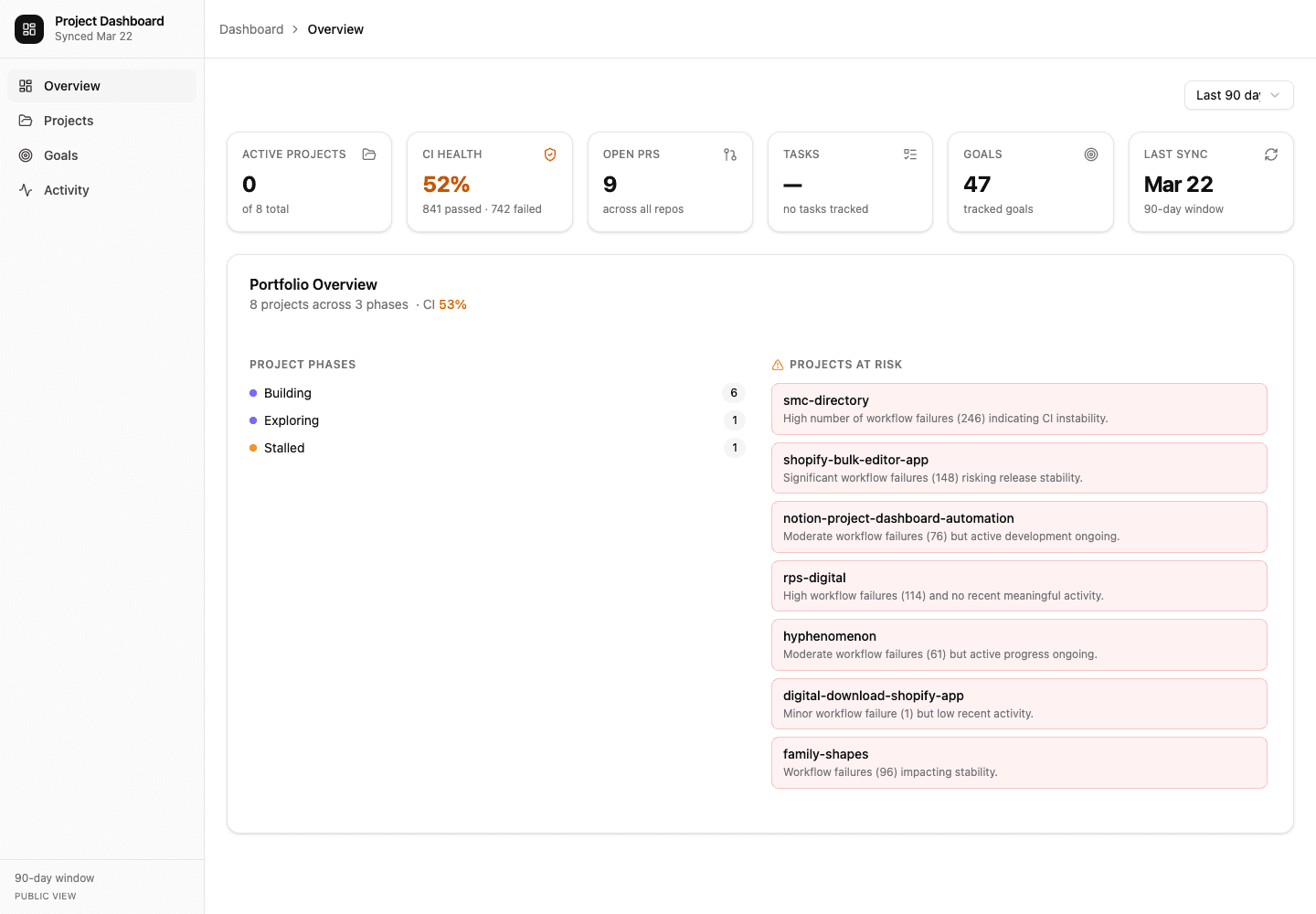
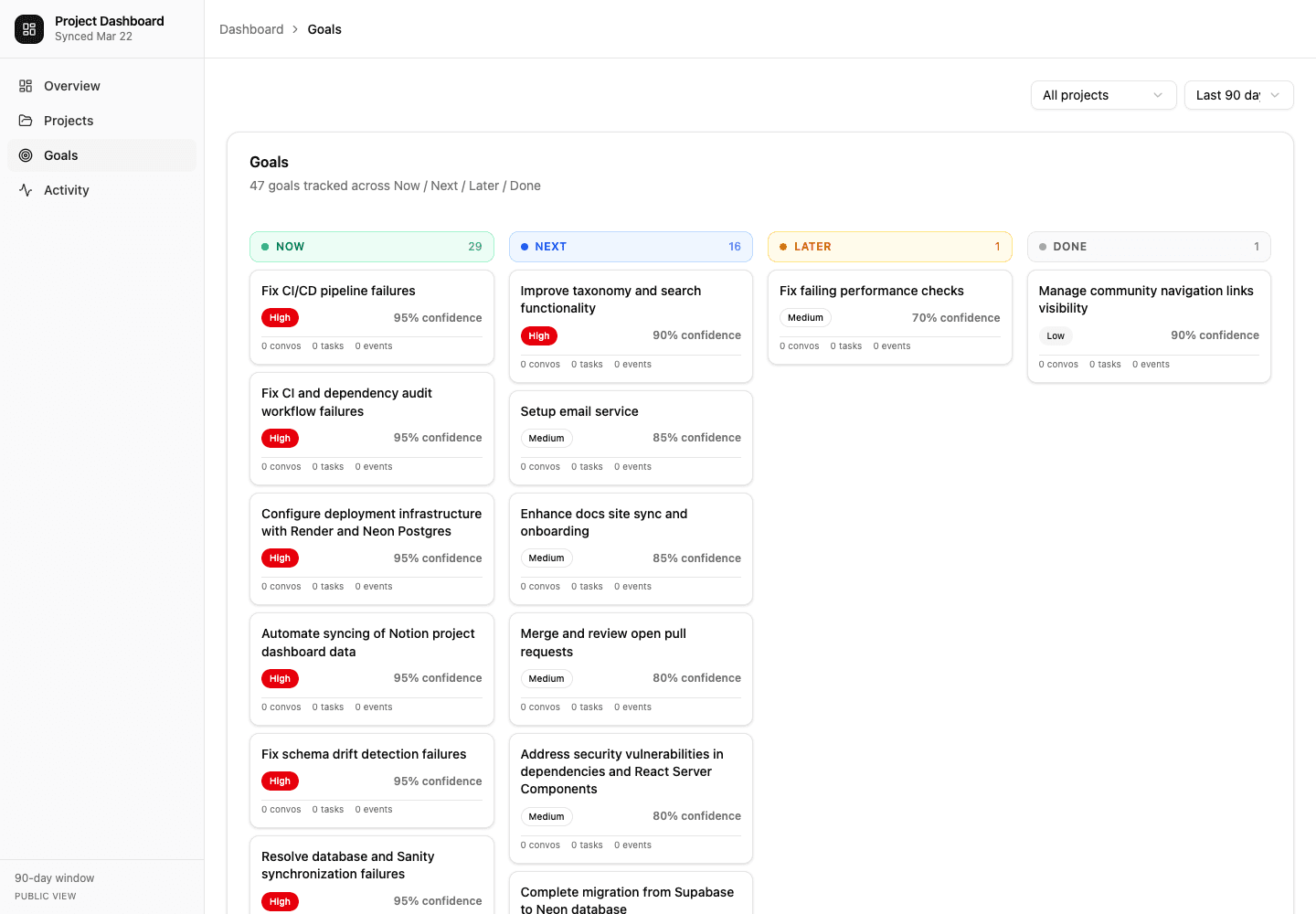
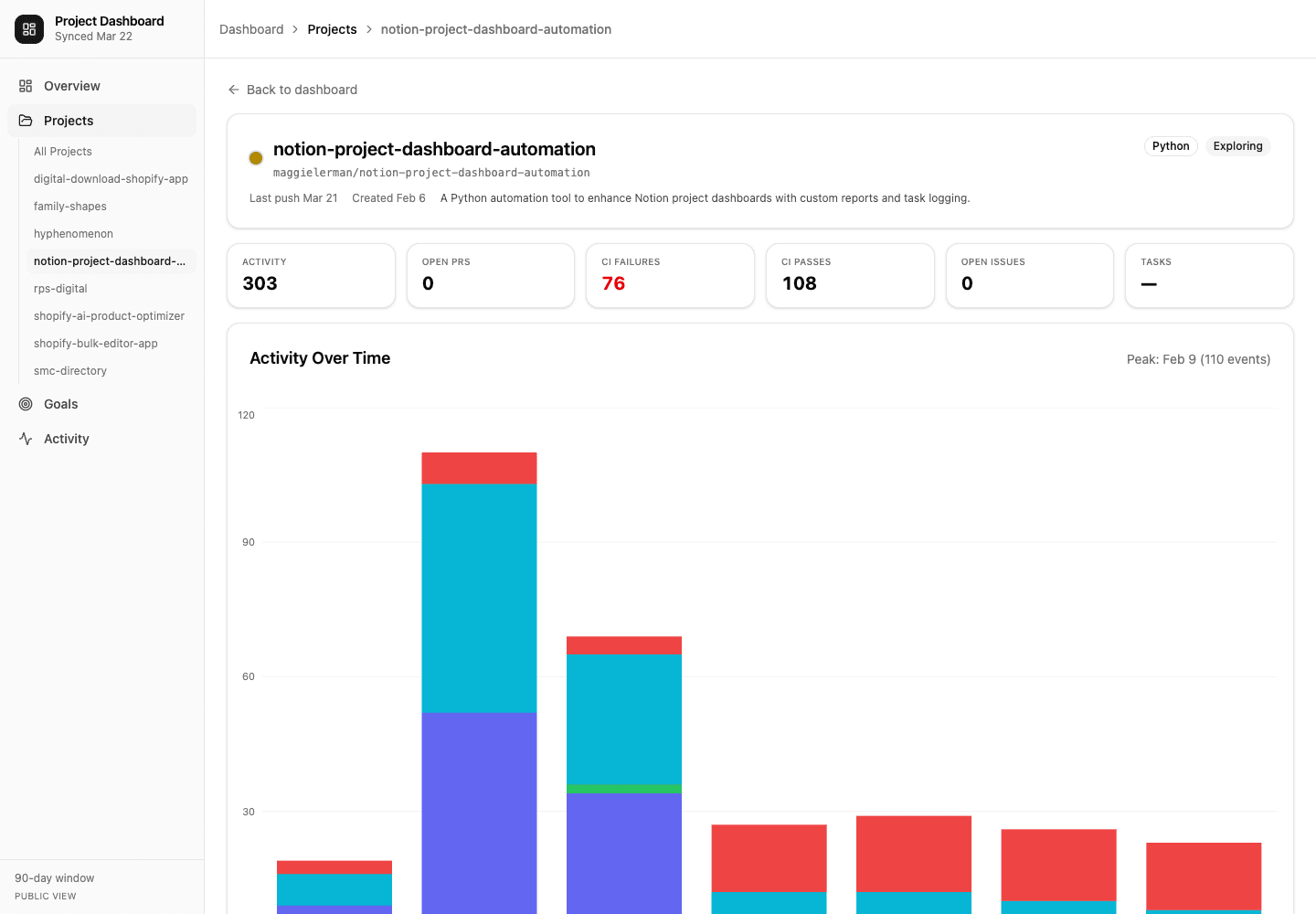
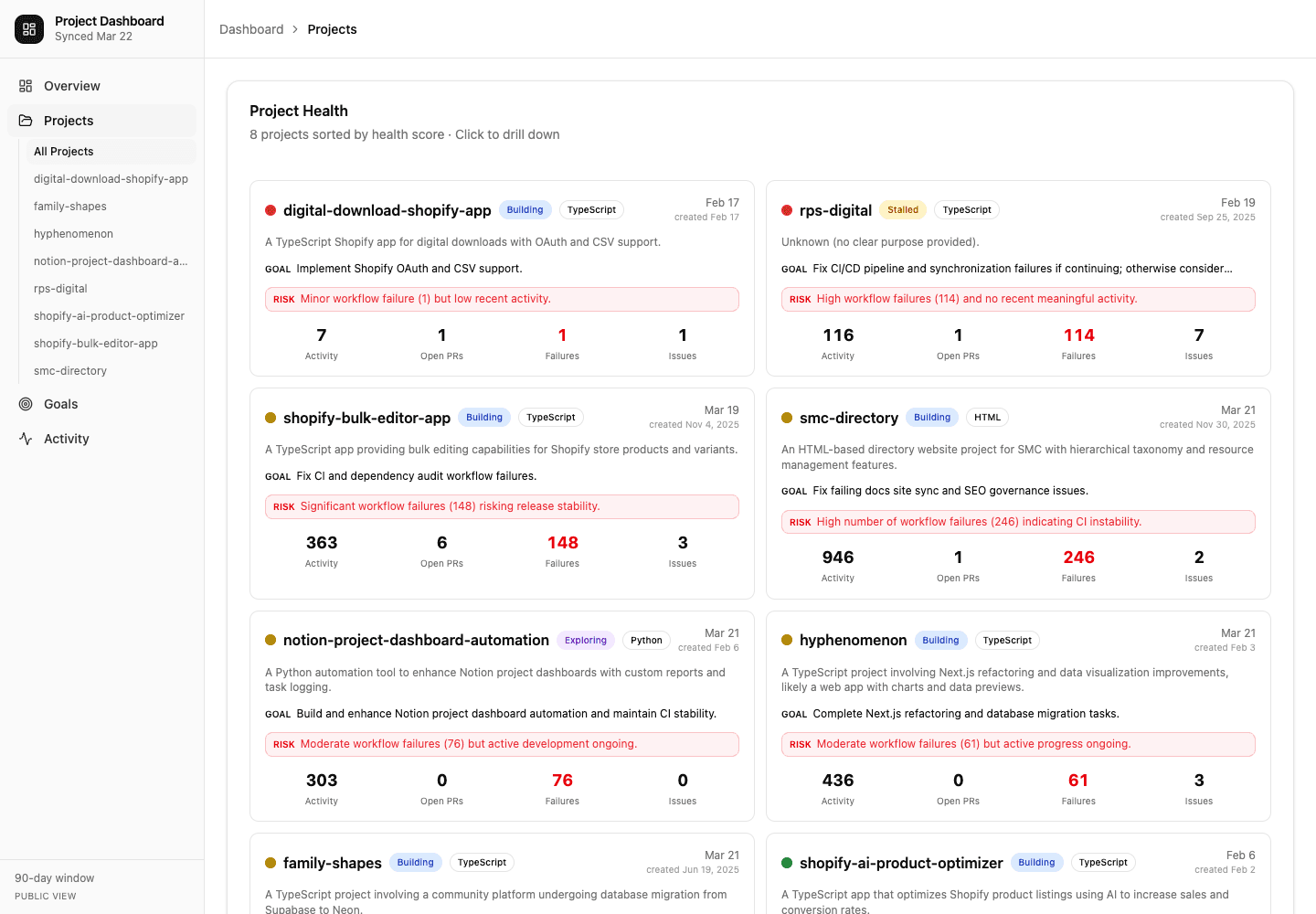
Read-only dashboard mode with landing page, portfolio KPIs, phase/risk summary, project health cards, goals board, activity chart, and repo drilldown. Verified locally at `/dashboard` with `VITE_SITE_MODE=public`.
Private operator dashboard
Private mode expects authentication and reads private snapshot data for the operator's full dashboard workspace.
Notion operating schema
Notion databases for projects, GitHub activity, conversations, tasks, goals, and AI runs keep the source of truth editable outside the dashboard UI.
Snapshot export and publish path
Normalized JSON/CSV snapshots power the dashboard and provide artifact proof for review, publish, and public-safe data paths.
Implementation stack
Automation and data layer
- • Python stdlib modules
- • Notion API
- • GitHub API
- • OpenAI API
- • structured JSON outputs
Dashboard
- • React 18
- • Vite
- • TypeScript
- • Tailwind CSS 4
- • Recharts
- • lucide-react
Deployment and docs
- • Vercel dashboard app
- • Better Auth
- • VitePress docs
- • Cloudflare Pages docs site
Evidence
13 artifacts grouped by type so each kind of proof can be scanned on its own.
Data models
1 artifactWorkflows
1 artifactImages
5 artifacts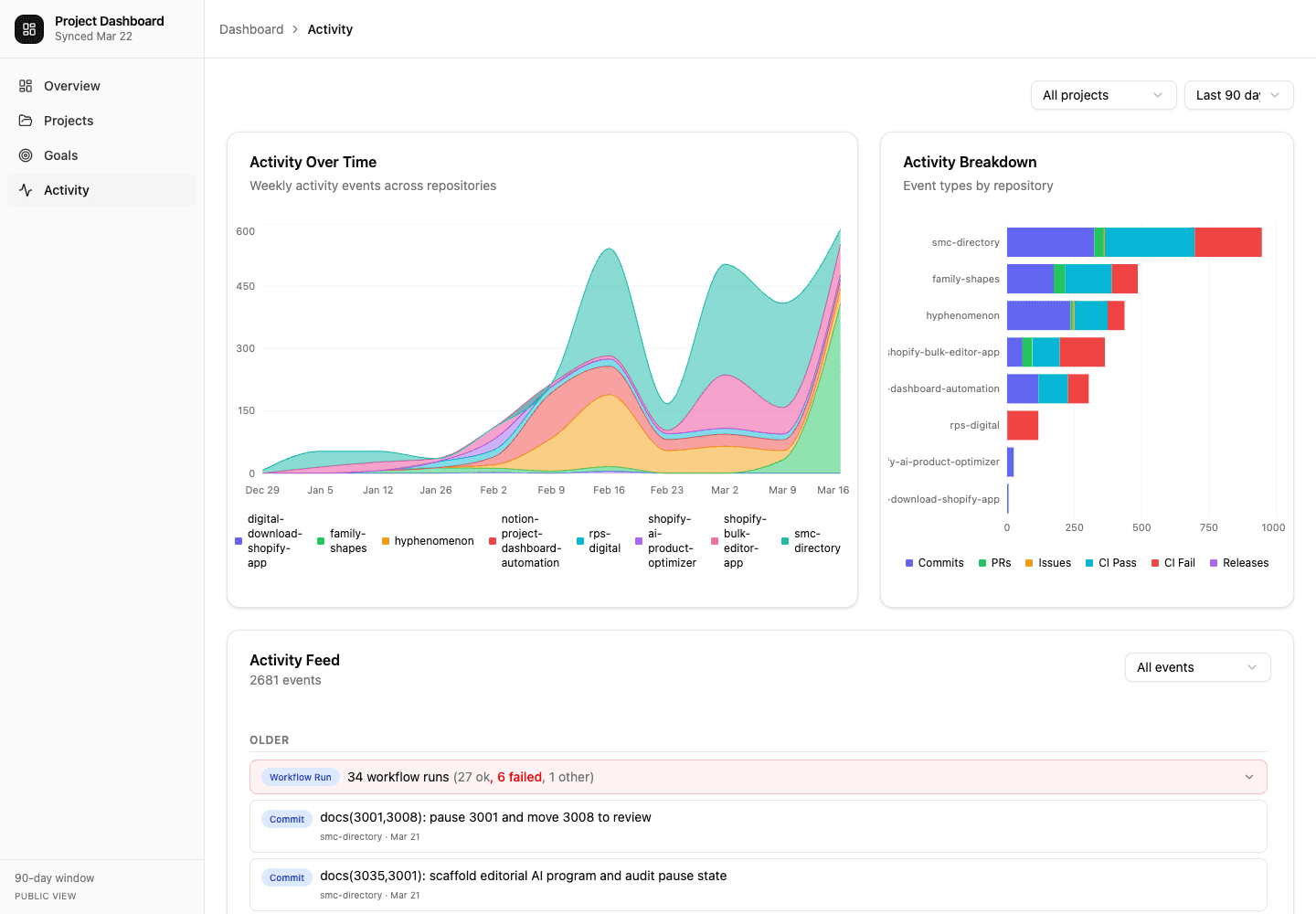
Notes
6 artifactsAutomated Project Tracking Dashboard (MLNNA) Intake Dossier
MLNNA primary README
MLNNA solution implementation
MLNNA strategist logic
MLNNA dashboard app source
MLNNA dashboard overview screenshot
Connected references
Key dates
Source history and planning lineage show the original Notion plus Observable dashboard plan and early dashboard implementation work.
Product brief, PRD, strategist logic, and solution implementation docs describe the portfolio strategy model and pipeline architecture.
Latest reviewed commit `deea8e94943ebdcd68405d9e6eff79e175ad1417` is `chore: disable repo automations`, which limits current-state claims.
Queue item `IQ-0013` was reviewed with fresh source evidence, local dashboard screenshots, and corrected Hyphenomenon-owned artifact layout.